Bodnant Garden gets quiet once the autumn colour drops, and that is when the National Trust garden near Colwyn Bay is most worth the trip from Llandudno. The lawns and summer borders stand mostly bare, but a separate winter garden keeps its own season, built on scent and bark and flowers that arrive when almost nothing else is out. Here is what is actually there between November and late January, what is open, and how to reach it with or without a car.
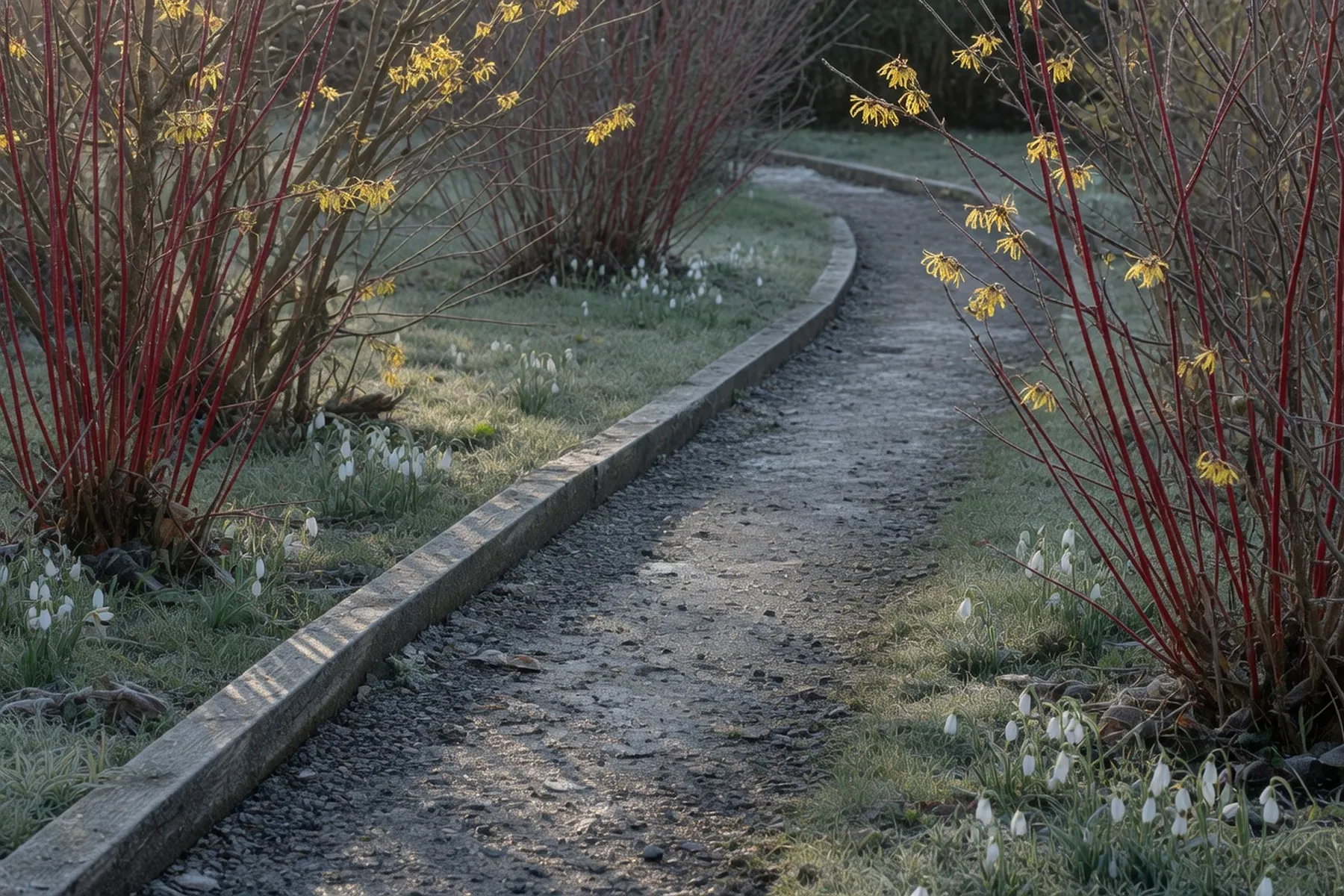
A summer visit to Bodnant is about the terraces and the laburnum in May. A winter one is about a smaller, denser corner of the same Grade I listed garden. The Winter Garden opened in 2012, carved out of an overgrown Edwardian rockery, and between November and February it holds most of the interest: witch hazel flowering on bare wood, shrubs whose perfume carries across a frosty path, snowdrops pushing through from January, and stems bright enough to read as flowers. The wider 80 acres stay open, but in the low season they are mostly structure and quiet, which is part of the appeal. You will share the paths with very few people.
The Winter Garden is not a glasshouse but an outdoor trail, a compact maze of paths that sits near the visitor centre. The National Trust describes the route as an easy circular walk of roughly half a mile, taking 30 to 60 minutes at a gentle pace, family-friendly and largely accessible. The surface is mostly level gravel and grass with a few shallow steps, and the trail passes the Laburnum Arch — pruned back in December and January, so you see its framework rather than the May tunnel of blossom. If you use a wheelchair, the garden has manual wheelchairs and a mountain trike available on a first-come basis, and the National Trust page has an access map and a 1.5 km accessible Rose walk as alternatives.
Witch hazel, Hamamelis, is the headline plant of the season, and it does something odd: the spidery flowers appear on bare branches, yellow, orange and coppery-red, in the coldest months. Look for the coppery-orange Hamamelis x intermedia ‘Jelena’ and Hamamelis mollis ‘Goldcrest’, a cultivar Bodnant itself raised. The petals can curl up in hard frost and unroll again as the air warms, and the fragrance is light and citrusy rather than sweet. The flowers run through most of the winter, so a visit in any month from November on should find some.
Much of the winter appeal is something you smell before you see. Sarcococca, sweet box, carries tiny white flowers with a strong, almost almond perfume, and Daphne bholua ‘Jacqueline Postill’ opens honey-scented pale pink flowers on a tall evergreen. Both sit along the Winter Garden paths, and on a still, cold day the scent hangs in the air longer than it ever does in summer. This is the part most round-up pages miss entirely, and it is the cheapest pleasure in the garden — walk slowly and follow your nose.
Snowdrops begin in January, first in the Winter Garden and later spreading through Old Park Meadow, and the exact timing moves with the weather, so treat “from January” as the honest answer and check the National Trust page if you are planning a visit around them. Around the same time the garden brings up hellebores, red-leaved bergenia, cyclamen, the pale blue iris ‘Katherine Hodgkin’ and early crocus. Ignore the pages that push snowdrops to February; Bodnant’s own guidance puts the first flowers a month earlier.
When there are no leaves, Bodnant leans on its stems. The dogwood Cornus alba ‘Sibirica’ glows red along the paths, and around it sit the mahogany bark of the Tibetan cherry, the pale trunk of Himalayan birch and the striped bark of the snakebark maple Acer conspicuum ‘Phoenix’. Low January sun is the best light for all of it — the same stems that look dull at noon in February take on colour in the hour after sunrise or before sunset, which is another argument for going on a clear day.
The garden is far from leafless. Winter-flowering rhododendrons such as ‘Nobleanum’ open in the cold, alongside camellias, garrya with its long grey catkins, skimmia, heathers and grasses that hold structure and seed heads through the season. One plant is worth seeking out deliberately: Bodnant holds the champion Osmanthus fortunei, the tallest in Britain, which carries small white flowers through the winter. It is the sort of record most visitors walk past without noticing.
If you are reading this in early November, you can catch the end of the autumn colour as well as the start of the winter display. The Acer Glade holds Japanese acers and cherries, the katsura gives off its burnt-sugar scent as the leaves turn, and there is liquidambar and berry cover in the woodland. Through Saturday 8 November 2026 the garden also runs its Calan Gaeaf monster trail, with Welsh monsters and mythical beasts and stories by the local author-illustrator Rowynn Ellis; there is no booking and normal admission applies, but check the National Trust Bodnant Garden page before setting out, as the trail’s details sit there.
Bodnant Garden sits at Tal-y-Cafn, near Colwyn Bay, with the address Bodnant Garden, Tal-y-Cafn, Colwyn Bay, Conwy LL28 5RE. By car it is off the A470 and signposted from A55 junction 19, and parking is free. The simplest car-free route from Llandudno is the number 25 bus, which stops outside the garden; if you prefer the train, the nearest station is Llandudno Junction, about 4.5 miles away, and you would finish the last leg by bus or taxi. The without-a-car guide covers Llandudno’s own stations and buses if you want the fuller picture.
The garden is open every day of the year and you do not need to book, with last entry 30 minutes before closing. In winter, November to February, the hours run roughly 10am to 4pm, but the National Trust page lists the exact daily times and a Christmas closure period, so check the board or the National Trust page rather than relying on a fixed time. Prices from 1 March 2026 are £20.90 for an adult with Gift Aid (£19 without), £10.50 for a child aged 5 to 17 (£9.50), free for under-5s, and £52.30 for a family (£47.50); National Trust members enter free. Dogs are welcome on short, non-extendable leads from 1 October to 31 March.
The Pavilion tea-room serves hot and cold light bites, lunches and cakes with indoor and outdoor seating, the Magnolia Cafe sits opposite the garden exit, and the shop and plant shop are open, with the Dell kiosk weather-dependent. Accessible toilets are at the car park, the shop and the Dell, and there are about 20 accessible parking spaces.
A December visit pairs neatly with the town’s own season. The Christmas in Llandudno guide sets out the 5 December parade and lights switch-on, the Santa Dash and the Venue Cymru pantomime, so follow that rather than doubling up here. Two more December fixtures sit alongside a garden day: the Victoria Centre Christmas market is listed as running from 27 November to 24 December, and the pantomime Sleeping Beauty runs at Venue Cymru from 12 December to 2 January — both come from listings rather than the organiser’s own page, so check the Victoria Centre and Venue Cymru sites for current dates. A workable winter day is the garden in daylight, then back to Llandudno for the lights.
Allow a full half-day from Llandudno: the Winter Garden trail takes 30 to 60 minutes on its own, and the tea-room, the shop and a slow second circuit stretch that comfortably. If you arrive by bus, time your return against the timetable rather than assuming a bus when you want one. Wear sturdy shoes rather than anything delicate — the trail is gravel and grass with a few shallow steps, and it can be wet after rain — and dress for standing still in cold air, because most of this is slow walking and stopping to look.